Stock Market

Order Types Explained: Market, Limit and Stop Orders

The order type you choose decides whether you control your price or your speed. Here’s when to use each.

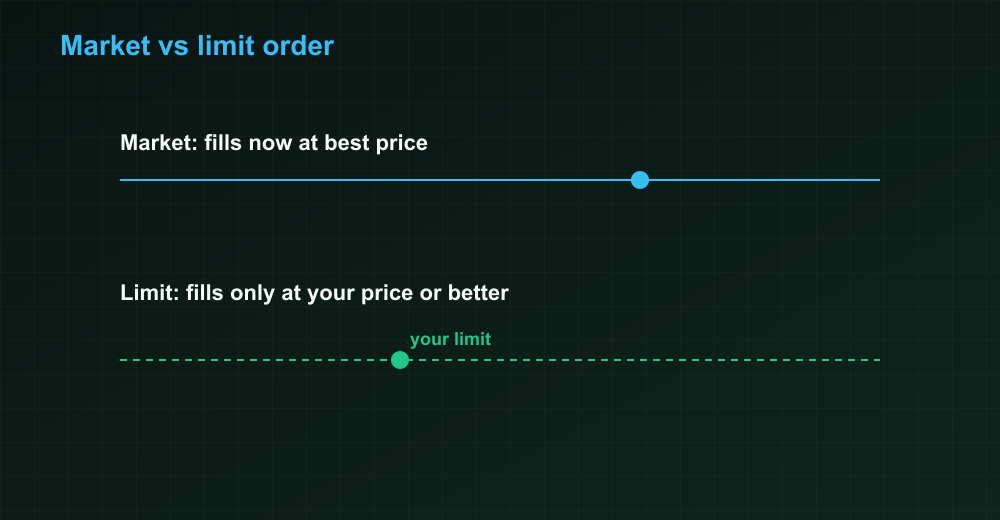
Diagram of market versus limit orders

An order is your instruction to buy or sell. The type you pick trades off price control against certainty of execution.
Market versus limit order diagram
A market order fills now; a limit order fills only at your price or better.

Market order

Fills immediately at the best available price. Fast, but you don’t control the exact price — risky in fast or thin markets.

Limit order

Fills only at your chosen price or better. You control the price but it may not execute at all.

Stop-loss and stop-limit

A stop-loss triggers a market order once price hits your level — used to cap losses. A stop-limit triggers a limit order instead, giving price control but risking non-execution.

Key idea: Careful traders favour limit orders to know exactly what they’ll pay, and always attach a stop-loss to cap risk.

Key takeaways

  • Market = speed, no price control.
  • Limit = price control, no fill guarantee.
  • Stop-loss caps losses automatically.
  • Match the order type to your priority: price or speed.

Practise this on ShareRocketPro

Sign up with your name, phone number and a password, get Rs. 10,000 in practice money and trade every NEPSE scrip in our 24/7 practice market — virtual money with no cash value, so zero real-money risk.


Apps — coming soon See NEPSE markets

#order types#market order#limit order#stop loss#beginners
FAQ

Quick answers.

What is the difference between a market and a limit order?

A market order fills immediately at the best available price; a limit order fills only at your specified price or better, but may not fill at all.

When should I use a stop-loss order?

On every trade — it automatically exits your position if price hits your predefined level, capping your loss.

What is a stop-limit order?

It triggers a limit order (not a market order) once your stop price is hit, giving you price control at the risk of non-execution.

Keep reading

More from the blog.

All articles →
Practise free

Now try it with practice money.

Put this idea to work in the ShareRocketPro app's 24/7 practice market, built from real NEPSE prices, with Rs. 10,000 practice money. Practice money has no cash value — there is nothing to lose but the lesson.