Strategy

10 Risk Management Rules That Keep Traders in the Game

You cannot control the market, but you can control your risk. These ten rules separate traders who last from those who blow up.

Shield illustration representing trading risk management

Ask any experienced trader for their secret and you’ll rarely hear about a magic indicator. You’ll hear about risk management.

Key idea: Your first job is not to make money. It is to not lose too much. Survival is what lets compounding work.

The 10 rules

  1. Risk a fixed small percentage per trade — the 2% rule.
  2. Always use a stop-loss.
  3. Size positions from your stop, not your gut.
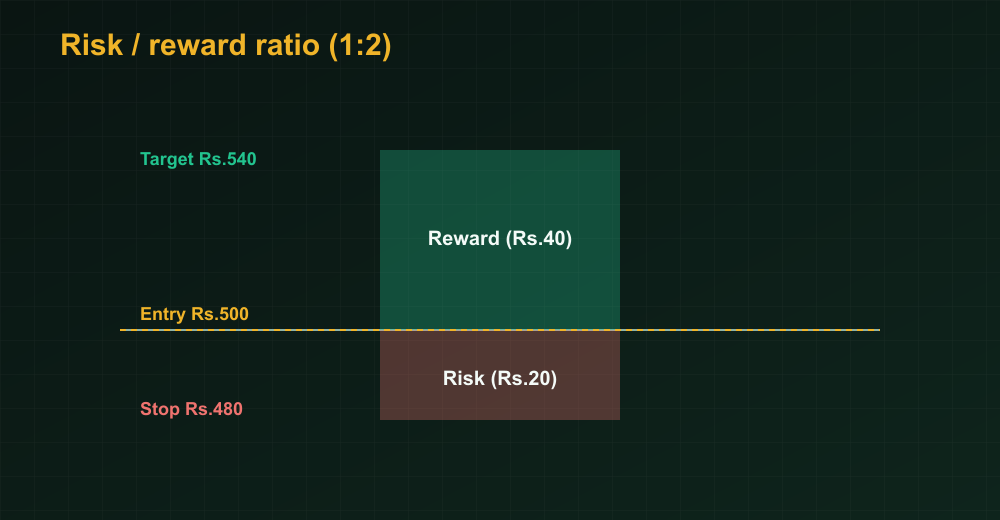
  4. Aim for at least 1:2 risk/reward.
  5. Never average down on a loser.
  6. Cap your daily loss.
  7. Diversify.
  8. Beware leverage.
  9. Keep a journal.
  10. Protect profits with a trailing stop.
Risk to reward ratio diagram
Aim for trades where the reward clearly outweighs the risk — 1:2 or better.

Position sizing example

Account Rs.1,00,000, risk 2% (Rs.2,000). Buy at Rs.500, stop at Rs.480 = Rs.20 risk per share. So you buy Rs.2,000 ÷ Rs.20 = 100 shares.
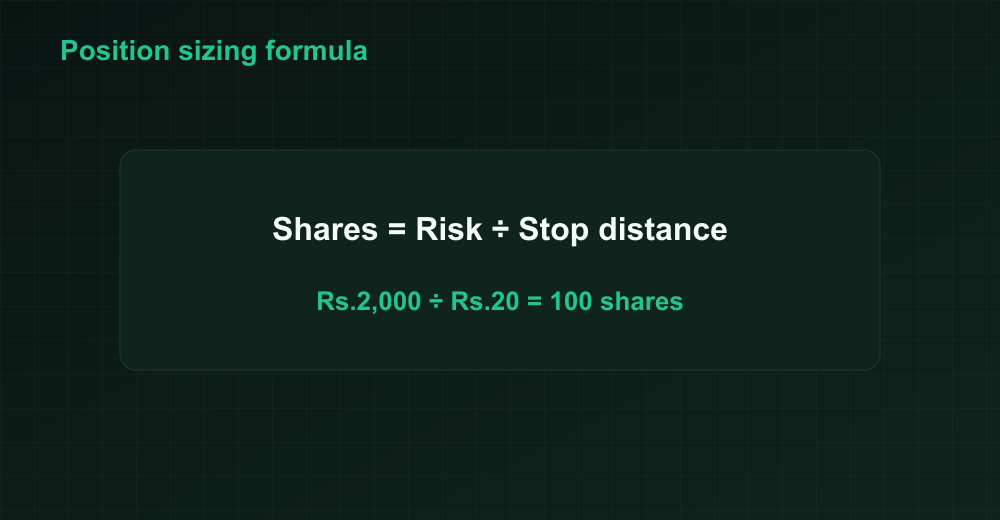
Position sizing formula
Shares = risk amount ÷ stop distance. The maths, not emotion, sets your size.

Key takeaways

  • Protect capital first — profits follow survival.
  • Fixed % risk + a stop on every trade.
  • Size from your stop distance.
  • Cap daily losses; never average down on losers.

Practise this on ShareRocketPro

Sign up with your name, phone number and a password, get Rs. 10,000 in practice money and trade every NEPSE scrip in our 24/7 practice market — virtual money with no cash value, so zero real-money risk.
Apps — coming soon See NEPSE markets

#risk management#position sizing#stop loss#strategy#2% rule
FAQ

Quick answers.

What is the 2% rule in trading?

Never risk more than 2% of your account on a single trade. It ensures no one loss (or losing streak) can seriously damage your capital.

How do I calculate position size?

Position size = risk amount ÷ stop distance. Example: Rs.2,000 risk ÷ Rs.20 stop distance = 100 shares.

What is a good risk-reward ratio?

Aim for at least 1:2 — risking one unit to make two. This lets you be profitable even with a sub-50% win rate.

Should I ever average down on a losing trade?

Generally no. Adding to losers increases risk on a position the market is telling you is wrong. Add to winners instead.

Keep reading

More from the blog.

All articles →
Practise free

Now try it with practice money.

Put this idea to work in the ShareRocketPro app's 24/7 practice market, built from real NEPSE prices, with Rs. 10,000 practice money. Practice money has no cash value — there is nothing to lose but the lesson.